Like many of you in the Pontiac, I’ve been closely analyzing the proposed $418M CAD Samonix land-based salmon farm in Litchfield [Samonix]. With the BAPE public hearings underway , I decided to do some homework on the project’s corporate structure, financial backing, and leadership board.
What I found is a massive contrast to Quebec's other major salmon project (AquaBoreal), and it raises some serious questions we all need to think about before any ground is broken near our river.
Here is the breakdown of the facts:
1. The Board: Bureaucrats, Not Fish Farmers
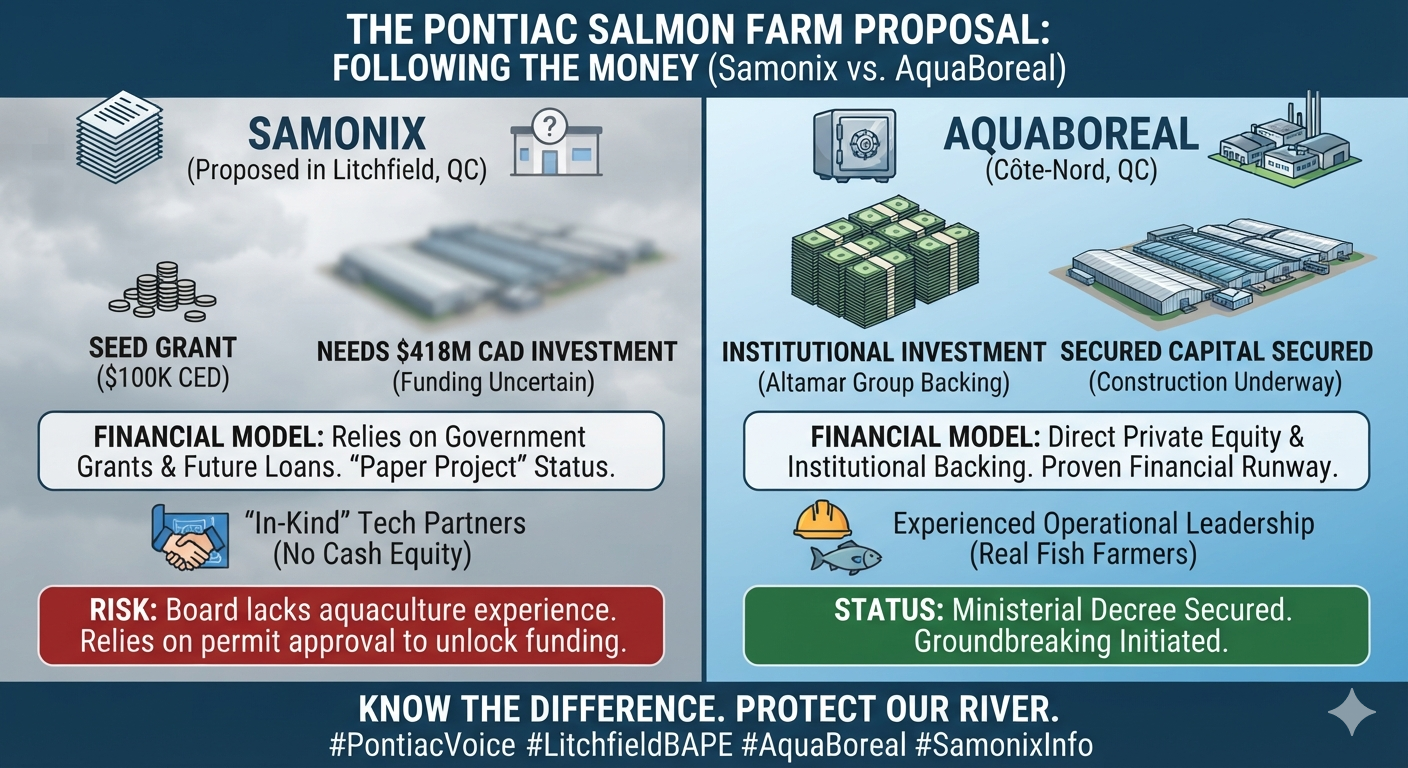
When you look at the leadership board of Samonix, one glaring truth stands out: they have zero experience in commercial salmon farming. The founder and president is a CPA and auditor. What they do have is extensive experience dealing with government institutions, federal procurement, and municipal red tape. They are "permit finders," not operational experts.
2. Follow the Money: Samonix vs. AquaBoreal
To understand how financially fragile Samonix actually is, you have to compare it to AquaBoreal—the land-based salmon project on the Côte-Nord. The difference in financial backing is night and day:
- AquaBoreal (The Institutional Cash Model): AquaBoreal has the direct, heavy financial backing of an established institutional investment firm (Altamar Group). They have real cash equity driving their pre-construction and development phases, and they have already secured their official Quebec ministerial decree.
- Samonix (The Government Seed Model): Samonix has very little hard cash of its own. They are surviving on small pots of founder money and a minor $100,000 repayable seed grant from Canada Economic Development [seafoodsource.com]. They still need to raise a staggering $418 million CAD in total construction capital [Samonix], which is currently frozen until they pass our local environmental reviews.
3. "No-Cash" Partners
So, how does a board without aquaculture experience or hundreds of millions in the bank plan to build a mega-facility? They are relying entirely on Scandinavian partners (Smart Salmon and Smögenlax).
Crucially, these European partners aren't sending cash. Instead, they are providing what is called "In-Kind Equity." This means they are trading their technical blueprints and specialized equipment for corporate shares in Samonix.
Conclusion: Is this project actually possible?
Financially and operationally, Samonix is a "paper project" hanging by a thread.
For this facility to become a reality, a very specific and fragile domino effect has to happen perfectly:
- They must use their bureaucratic skills to bypass the BAPE hearings and local environmental opposition (including major concerns from groups like the Ottawa Riverkeeper over water temperature and effluent [ottawariverkeeper.ca]).
- They must use those government permits as collateral to convince commercial banks to give them hundreds of millions in loans.
- Their European partners must successfully install and run highly complex Recirculating Aquaculture Systems (RAS)—a technology that has faced massive, multi-million dollar operational failures all over the world when not managed by elite teams.
My Take: The current board's only real job is to use their government relations expertise to get the government's blessing. Once the permits are secured, the local founders will likely either be heavily diluted or sell the project entirely to international operators who actually know how to farm fish.
Until they show us hard construction cash and real, on-the-ground operational leadership—rather than just smooth talk and government grant applications—we as residents should remain highly skeptical about the long-term viability of this project on our shores.