
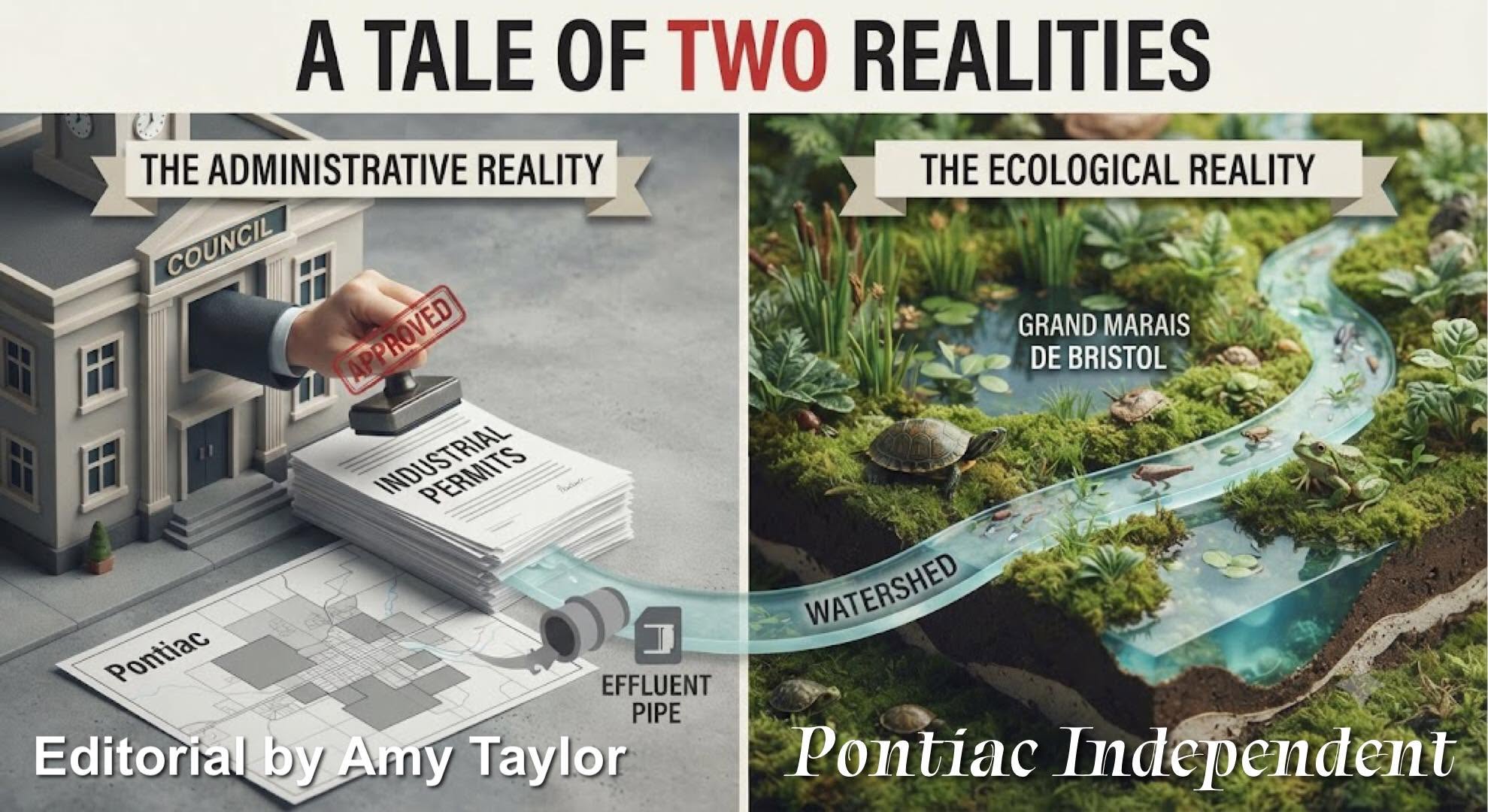
The previous MRC Pontiac council of mayors largely embraced large-scale industrial projects with minimal friction—remember the massive incinerator dream?—and it appears the current council may quietly follow in their footsteps.
Recent conservation milestones and independent document reviews highlight a stark disconnect between administrative rubber-stamping and the fragile ecological framework that defines our region. Consider the timing. Just as the Canadian Herpetological Society officially recognized the Grand Marais de Bristol as an Important Amphibian and Reptile Area (IMPARA)—highlighting a vital scientific reminder and an irreplaceable haven for vulnerable species that lacks formal provincial legal protection—leadership continues to roll out the red carpet for heavy commercial proposals along the same shared watershed.
It is a striking contradiction: while the region proudly points to massive public conservation wins further north, such as the 852 square-kilometer interim biodiversity reserves established across the Noire and Coulonge river basins, southern ecosystems are left to fend for themselves against ad-hoc industrial creep.
The friction points to a recurring structural problem in Pontiac governance: while independent grassroots groups and individual citizens are busy analyzing complex project disclosures, local officials have historically shown an eagerness to fast-track development without demanding rigorous, community-led deliberation.
All too often, public consultation happens after the fact, if at all. We saw this when residents called for a public consultation regarding rising property taxes and more recently when the municipalities of L'Isle-aux-Allumettes, Chichester, and Sheenboro overhauled their waste management systems before looping in the public, and we are likely to see more of the same as these administrations put their $525,000 provincial grant toward "inter-municipal collaborations"—fancy words for amalgamation.
When the Samonix aquaculture proposal surfaced in Litchfield, the project benefited from existing industrial zoning on a shuttered brownfield site along the Kitchisippi/Ottawa River. Because the zoning was already technically in place, it was treated largely as a done deal rather than an opportunity for expansive, localized public discussion. It fell entirely to independent civic voices, including the Pontiac Independent’s own review of project files, to unpack what it actually means.
Amphibians, reptiles, and specialized aquatic life forms act as the ultimate biological check-balances of our ecosystem. Because creatures like turtles and frogs rely seamlessly on both clean land and untainted water, they are acutely sensitive to chemical changes, nutrient loading, and industrial discharge.
When a wetland like the Grand Marais de Bristol receives formal recognition as an IMPARA site, it serves as a vital scientific reminder: the MRC Pontiac is not an empty industrial corridor waiting to be filled; it is a complex, living ecosystem.
Yet, industrial proposals that introduce treated effluent streams into the shared Ottawa River basin, even with high-recirculation technology, rely heavily on public trust. And trust is precisely what wears thin when municipal councils treat major ecological additions as administrative checkboxes, leaving residents and independent groups to connect the dots between upstream footprints and downstream vulnerability.
Elected officials can lean on the argument of economic development and modernization, framing industrial growth as an unalloyed good. But true local stewardship requires looking at the MRC Pontiac as an integrated whole. You cannot celebrate regional biodiversity and environmental grants with one hand while waving through complex industrial operations without exhaustive local debate with the other.
When municipal leadership abdicates its role as an active, critical watchdog, it shifts the heavy burden of inquiry onto the public. Too often, officials skip their due diligence, eager to accept a promoter's pitch for the sake of an easy economic pat on the back. If our elected officials continue to view our watershed as an administrative obstacle rather than a living inheritance, what kind of Pontiac are we leaving behind for the next generation?