
Why Freshwater Fish Farms and Atlantic Salmon Farms Are Not the Same
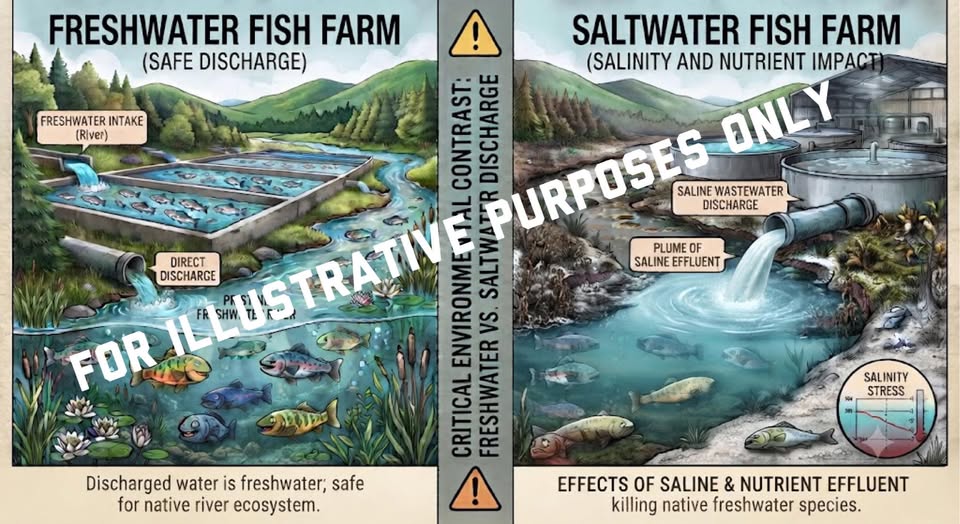
Editorial Illustration Note: The accompanying visual is a conceptual diagram illustrating the general environmental dynamics of freshwater flow-through systems versus land-based saltwater Recirculating Aquaculture Systems (RAS) discharge.
As discussions continue about the proposed Samonix Atlantic salmon project in Litchfield, it's important to recognize that not all land-based fish farms are directly comparable.
Freshwater fish farms, hatcheries, and Atlantic salmon grow-out facilities operate under very different biological and engineering conditions. Comparing them as though they are equivalent can lead to misleading conclusions because the differences extend far beyond the species being raised. The most significant distinctions involve water chemistry, production systems, wastewater characteristics, and potential environmental considerations.
Freshwater species such as trout and walleye spend their entire lives in freshwater. Their production systems use freshwater from beginning to end, and after treatment, the discharged water remains freshwater.
Atlantic salmon have a very different life cycle.
They hatch in freshwater, migrate to the ocean as smolts where they spend most of their lives growing, and later return to freshwater to spawn. Commercial Atlantic salmon production is designed to accommodate this biological transition.
Today, salmon production generally follows one of two approaches:
Traditional salmon farming raises juvenile salmon in freshwater hatcheries before transferring them to marine net pens for grow-out.
Land-based Recirculating Aquaculture Systems (RAS) either transfer freshwater smolts into land-based systems using brackish or seawater, or gradually increase salinity within the system to mimic the transition from freshwater to marine conditions.
Salinity fundamentally changes how a Recirculating Aquaculture System operates. It affects biological filtration, corrosion control, equipment design, microbial communities, waste treatment processes, and the chemical composition of the final effluent.
These differences influence both treatment requirements and the types of environmental questions that regulators, scientists, and communities need to consider. For this reason, comparing a freshwater trout or walleye farm, or a freshwater hatchery, to a large Atlantic salmon grow-out facility is not an apples-to-apples comparison.
Canada has several land-based Atlantic salmon hatcheries and a limited number of commercial land-based Atlantic salmon RAS facilities. However, few currently operate at the scale proposed for Samonix. If constructed at its proposed production capacity of approximately 10,000 metric tonnes annually, the facility would be among the largest land-based Atlantic salmon grow-out operations in Canada and one of the larger land-based Atlantic salmon RAS projects in North America.
That scale alone makes comparisons with small freshwater trout farms, walleye operations, or hatcheries scientifically limited.
The receiving environment is also an important consideration. Many large Atlantic salmon facilities are located on or near coastlines where seawater is readily available and treated marine or brackish effluent is discharged into naturally saline marine environments.
A project proposing to discharge upwards of 70,000 litres of treated brackish or saline water into a freshwater river daily presents a different scientific scenario.
That does not automatically mean the discharge will cause environmental harm. Modern treatment systems are designed to remove suspended solids and reduce nutrient concentrations before discharge. However, conventional wastewater treatment does not typically remove dissolved salts, so salinity remains an important factor requiring evaluation. Freshwater ecosystems generally respond differently to elevated salt concentrations than marine environments, making direct comparisons with freshwater aquaculture facilities scientifically inaccurate.
Understanding these distinctions is not about supporting or opposing the project, but rather about informed discussions and decision making.